H.1-L01 Machine families
Skill ID GC-H-001 · Foundation · about 8 h · Module H.1: Machine families & attachments
Learning outcomes
- Describe the main machine families used in demolition and what each is for.
- Select a suitable machine family for a described task and justify the choice in writing.
- Recognise when a task needs a purpose-built machine rather than the one already on site.
Explanation
The hydraulic excavator is the core demolition machine. Fitted with the right attachment, it breaks, crushes, cuts, sorts and loads. Demolition-specification excavators differ from earthmoving machines: heavier guarding (H.1-L03), reinforced booms and arms, extra hydraulic circuits for attachments, often a wider or extendable undercarriage for stability, and sometimes a tilting or raised cab for visibility.
The main families:
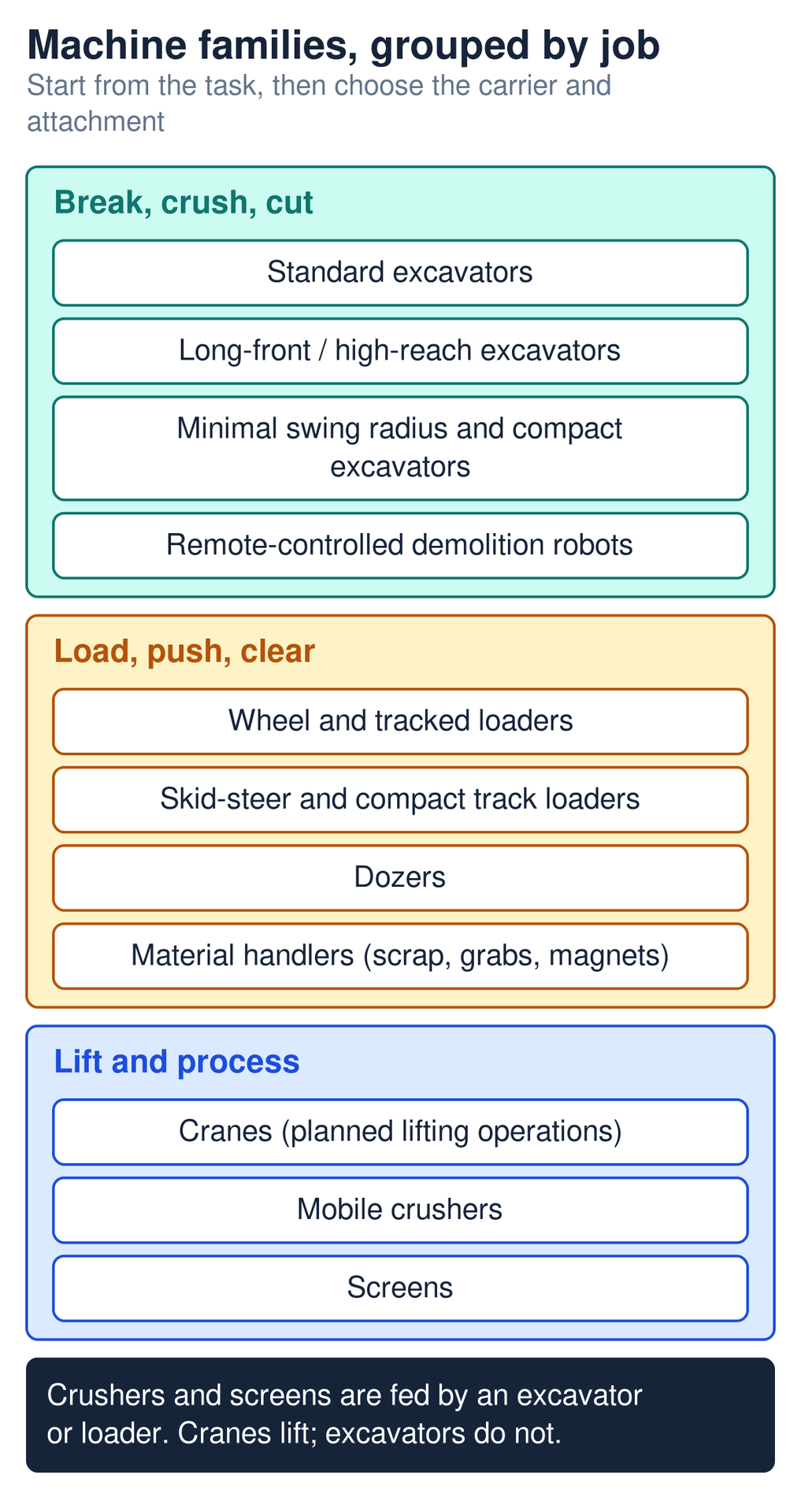
- Standard excavators (compact to about 50 t and above): general demolition to modest heights, processing, sorting and loading. Choose by reach, the weight of the attachment needed, and the access and floor or ground conditions.
- Long-front and high-reach demolition excavators: a purpose-built multi-section boom that puts an attachment high up the structure while the machine stays on the ground (H.2-L04). Many are convertible between a high-reach front and a standard digging or demolition front.
- Minimal swing radius and compact excavators: for tight sites and interior work; check that they are rated for the attachment and the protective guarding needed.
- Remote-controlled demolition robots: compact, tracked carriers with outriggers, operated from outside the machine (H.1-L05).
- Wheel loaders and tracked loaders: loading trucks, moving stockpiles, feeding crushers. Fast on good ground; not a demolition machine.
- Skid-steer and compact track loaders: sweeping, loading, light breaking with small attachments, interior clean-up. Guarding and visibility limit their use near falling material.
- Dozers: clearing, pushing arisings, building ramps and pads, levelling at handover.
- Cranes: lifting out sections cut free (dismantling), lifting machines onto structures, removing plant. Lifting is a planned operation under the lifting rules that apply (for example, LOLER 1998 in Great Britain, OSHA 29 CFR 1926 Subpart CC for cranes in the US).
- Mobile crushers and screens: processing concrete and masonry into recycled aggregate on site (O.2-L01). Fed by an excavator or loader.
- Material handlers: for sorting and loading scrap with grabs or magnets.
Selection logic. Start from the task, not the machine you own:
- What is being demolished, how high, how thick, what material?
- What access, ground or floor capacity, and headroom are there?
- What attachment does the task need, and what carrier can safely carry and power it?
- What are the exclusion zone and neighbour constraints?
- Can the machine work within manufacturer limits throughout the sequence?
Purpose-built beats improvised. In Great Britain, the Provision and Use of Work Equipment Regulations 1998 (PUWER) require equipment to be suitable for the purpose for which it is used. HSE's guidance is that an excavator is not normally the most suitable machine for lifting operations, which should first look at machines designed for lifting. The same principle applies everywhere: an excavator stretched beyond its reach, or a compact machine carrying an oversized breaker, is a predictable incident.
Key terms
- Carrier: the base machine (excavator, robot, loader) that carries and powers an attachment.
- Front: the boom and arm combination of an excavator (standard, demolition, long-front, high-reach).
- Minimal swing radius (MSR) excavator: an excavator whose upper structure swings within a small radius, suited to tight sites.
- Material handler: a machine designed for handling loose material and scrap with grabs or magnets.
- PUWER: Provision and Use of Work Equipment Regulations 1998 (Great Britain).
Diagram
Worked example: choosing a machine family
Task (illustrative): remove a three-storey RC frame (11 m to roof) next to a live road, then process the concrete on site.
- Height 11 m: within reach of a large standard demolition excavator with a long demolition front (check the manufacturer's working range chart for the chosen configuration).
- Live road: demolition must pull material inward, away from the road; a top-down sequence with a pulveriser gives control. A high-reach is not needed for 11 m but a longer front gives more stand-off.
- Processing: mobile crusher fed by a second excavator with a bucket or sorting grab.
- Loading: wheel loader for crushed stockpiles and truck loading.
Written justification: "45 t class demolition excavator with demolition front and pulveriser for structure (reach chart ref. __ shows __ m at __); 25 t excavator with sorting grab for processing; mobile jaw crusher; wheel loader. Selected to keep the structure being pulled inward from the road and to keep processing separate from demolition."
Watch: free videos
- Every Construction Machine Explained in 15 Minutes (Practical Engineering). A general tour of the machine types seen on construction and demolition work.
- Volvo Demolition Equipment - Purpose built for demolition (Volvo Construction Equipment). A maker's view of what makes a machine purpose-built for demolition.
Free third-party videos. RazeForce does not make or control them. Use the manufacturer's documents for any limit or setting.
Job aid: machine selection record
| Task | Height / reach needed | Material and thickness | Access / ground / floor limits | Attachment | Carrier (class, front) | Manufacturer chart ref. | Exclusion zone | Selected by / date |
|---|---|---|---|---|---|---|---|---|
Practical task
Pick a job you know, or use the hypothetical three-storey frame in the worked example. Complete one row of the machine selection record: task, height or reach needed, material, access and ground limits, attachment, carrier class and front, manufacturer chart reference, exclusion zone. Then write a two-sentence justification, as in the worked example.
References
- HSE, L22 Safe use of work equipment: PUWER 1998 Approved Code of Practice and guidance (regulation 4, suitability).
- HSE, Excavators and LOLER (FAQ) and Lifting Operations and Lifting Equipment Regulations 1998 (LOLER) overview.
- OSHA, 29 CFR 1926 Subpart T Demolition (§1926.856 removal with equipment; §1926.859 mechanical demolition); Subpart CC Cranes and Derricks in Construction.
- BSI, BS 6187:2011 Code of practice for full and partial demolition.
Related Machinery Library cards (RazeForce Academy library): ML-01 Demolition excavators and high-reach machines; ML-02 Mini excavators and remote demolition robots; ML-06 Wheel loaders, backhoe loaders and skid steers; ML-07 Dozers; ML-08 Cranes used in demolition; ML-09 Mobile crushers and screens; ML-10 Material handlers.
Skill ID: GC-H-001 · Level: Foundation
rf_managed:GC-H:lesson:H.1-L01
There are no comments for now.